Friday, May 02, 2014

May, 2014, Seven Months into the Callair

The thing about restoring an airplane is that unless you have an idea of what the process entails, you're likely to think somewhere along the way that it sure looks like an awful mess. Something like watching someone else get a haircut. Have you ever wondered why the barber never has your chair facing the mirror? That's why.

Lots of pictures ... first, a starting weight, then many, many shots of how things went together before ...

How does it go? The head bone connected to the neck bone ... 
etc ...

etc ...

etc ...

By the time an airplane has reached its 62nd birthday it's likely to have picked up a few warts, bruises, and patches.

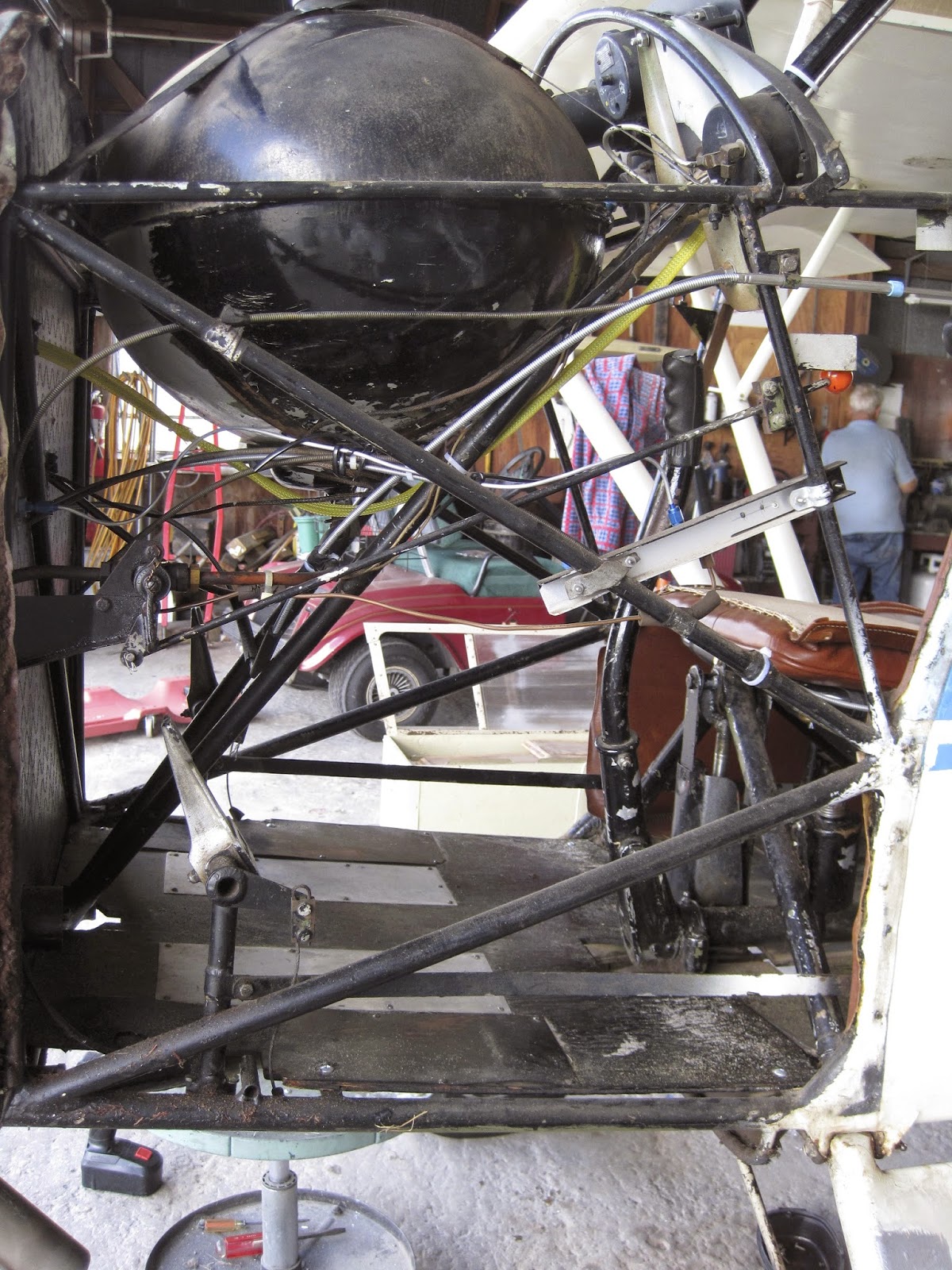
Peeling back the layers ...

one layer at a time ...

... and the neck bone connected to the shoulder bone ...

Some builder techniques provoke certain questions, usually beginning with "why...?"

The old braking system was right out of Rube Goldberg (or Massey Ferguson) ...

a major goal is FAA approval of a modern brake system that will have continued support.

To be sure, there are repairs and updates required throughout.

I tried to preserve the dirt dauber nest over the tachometer for posterity but it turned to sand in my hands. No telling how old that was ...

Dem bones, dem bones, dem dry bones ...

Even the most seemingly useless pictures can come in handy later when you're trying to figure out where and how and sometimes why things were done the way they were.

...
Then a few parts are readied for re-cover and ...
 
color charts are consulted ...
To take us back to Afton WY in 1952, when it all began.


Wednesday, April 16, 2014

Serendipity

ser-en-dip-i-ty [ser-uhn-dip-i-tee]
noun
1.   an aptitude for making desirable discoveries by accident.
2.   good fortune; luck.

Funny, the more I work at something, the luckier I seem to get. On rainy days there's nothing more handy than the internet for finding out stuff, and so it came to pass that I recalled a conversation last year with an interesting fellow who held a key to the history of my Callair S-1A. He gave me two names; a long year later I decided to look them up.

The first man I spoke to was a gentleman, it turns out, who I spoke with last year in my initial rush to find out more about the airplane. Herb Andersen moved to Afton WY in the 1950s to work for the CallAir Aircraft Company. He was the first to tell me that the Calls never built an S-1A entirely from scratch - the two airplanes were built up from Interstate Cadet parts and somehow one was badged as a CallAir. In my digging, I found a couple of S-1 airplanes called "CallAir" that are no longer on the FAA registry with serial numbers that were in the Interstate range of numbers, but mine was quite different ... it was a CallAir number, one of two aircraft built with that unique feature. I'll give my theory about that later, in another post.

Herb went on to a distinguished career with Mooney, Aero Commander and Piper before meeting with the legendary Curtis Pitts about the idea of moving the manufacturing of the Pitts Special aerobatic airplane to Afton. The result was Pitts' moving his company to Wyoming, joined later by Frank Christensen and the development of the Christen Eagle aerobatic airplane and the Aviat Husky utility aircraft. The robust aircraft manufacturing business in Afton today proceeds directly through these men to Reuel, Barlow and Spencer Call and the CallAir Aircraft Company. In 2010, Herb was awarded the Curtis Pitts Memorial Trophy for Innovative Aerobatic Design, preceded by his induction into the Wyoming Aviation Hall of Fame in 2003.

My next stroke of exceptional luck was to meet by telephone Major General Boyd Eddins, USAF Retired, shown here with his Brigadier stars. In 1952, General Eddins was a teenaged college kid, working in the CallAir Aircraft factory for 60 cents an hour and actually took a hand as my airplane was built. Mr Reuel Call offered to sell it to him for $2,800, more than 60 cents an hour could afford and a sum that would derail the young man's plans for a university degree and a career in the Air Force. 

General Eddins eventually served in a number of public positions, including the Wyoming legislature, before his retirement and, today, enjoys flying his RANS S-6 in the beautiful Star Valley that cradles Afton.

My dilemma with the restoration of this airplane hasn't been so much the nuts and bolts of the operation - Malcolm is in charge and doing a beautiful job of that. The tough part was finding the original paint scheme and colors. Nobody seemed to remember other than a black and white photo of Serial Number 1001 and the nugget that Barlow Call, owner of 1001, liked red and white airplanes. But what about Serial Number 1002, Mr. Reuel Call's airplane? The answer came as a complete surprise: General Eddins so loved that airplane that he kept a color photograph of it sitting in the final assembly building, framed in his home:
It is yellow with a blue accent, edged in white; Reuel Call's favorite airplane colors.

So now we know. Everyone with even a passing interest in the restoration of this airplane has a new spark of excitement. The paint order will go out next month and with Malcolm proceeding apace with covering, there is a glimmer of light at the end of the tunnel.


Saturday, March 29, 2014

The Callair, March 2014, - a progress report

Nuts and bolts are not particularly glamorous to most people but, then again, ones and zeros have the same cachet to most of us. Same with the making of sausage. It's not my usual place of endeavor, but once in the grease and grit, once loosening and tightening, once burnishing the rough spots off fresh-cast parts, the restoration of this airplane becomes a singular focus; takes on a life of its own. Of course, Malcolm is the wizard of the g&g, l&t and burnishing - I'm mostly a bystander. As coach once said, not everyone is an athlete but everyone can be a supporter.

The bare bones of the fuselage are resting on sawhorses now - the landing gear is off and various tabs and fittings, no longer needed, are being removed before new tabs and fittings are welded into place to accommodate the new, current technology, FAA-blessed brake system. 

The bare bones (the airplane, not Malcolm)

Pretty ribs, all in a row.

Some parts have to be persuaded before they can be disassembled and cleaned.

All the work so far is preparation for the media blasters - once in their shop, the steel parts will be thoroughly cleaned of 60-year-old rust, dirt, grease, paint, primer and gunk, then it's back to Malcolm's shop for a last wash with solvent, a couple of coats of protective primer and reassembly.

So far we haven't found a record of the original paint colors or scheme on my airplane (serial number 1002) so we've selected the original paint scheme for serial number 1001, though it won't be black and white. This is the only photo we've found of the Callair-produced Cadet. We're still hoping to find a color version to replicate the paint as closely as possible to the original.

***NEWS FLASH***
See my April 2014 entry, "Serendipity", for an original 1952 color photo of the airplane!
All in all, the project is moving right along.


Saturday, March 08, 2014

Pieces of Dreams - Rick Thompson's Fairchild restoration

One by one, the myriad of parts of a magnificent airplane are coming together. This little bit here, that little bit there, every one touched by my friend, Rick's, artist's hand. Click on each picture as you read to make it larger.

Note the work accomplished since our last post: the picture on the left is from March, 2013; the one on the right is six months later: September 2013. From these vantage points you can see a fair amount of work has been done: The tail is taking shape and the airplane is "on the gear" by September.

Again, left to right. The picture on the left is from July, 2013 and the one on the right is from February, 2014. By February the vertical stabilizer and rudder were covered and painted and the windshields and trim around the windshields were installed. Note that bowl-shaped apparatus hanging on the front; that is a heat shield shroud called, by antique airplane aficionados, a "dishpan", because it looks like one. That shroud deflects heat from the engine toward the outside of the engine compartment and away from accessories and appliances that occupy the space between the engine and firewall, such as the oil tank, various electrical components, etc.
Going back to September, 2013, the engine cowling was trial-fitted. That "dishpan" shown in the photos above fits inside this cowling. Note the blisters on the outside of the cowling. Those allow room for the intake and exhaust valve covers within an otherwise very crowded space. The cowling fits around the engine fairly tightly to take best advantage of airflow for cooling. The fabric draped over the aft fuselage will be used to cover the tail surfaces.
By February 18, 2014, the original registration numbers and a Fairchild decal adorned the rudder. Note also, the red trim on the leading edge of the vertical stabilizer. The fabric and paintwork are exquisite, evidence of Rick's skill and attention to the smallest detail.

And another look at the tribute to the aviatrix for whom the airplane is named ... "To honor our distant cousin. My cousin Tim's and my grandmother were sisters, we thought it would be fitting to name the ship "Amelia" after our grandmothers' 3rd cousin. Growing up as boys, the name of Miss Earhart was spoken in the family with great reverence." -Rick. 

Next up: Landing gear shrouds, cabin doors and, later this year, Wings.

Fly safe. Stay tuned.

For a chronology of Rick's project, take a look at these prior posts:


Monday, March 03, 2014

February is for Flying (as long as you're in Florida)

While the rest of the country shivers and shovels snow, those of us who are blessed to live in nature's paradise (or what's left of it) open the hangar doors, flip the propellator to seek adventure - and, usually, food - where we can find it. There are migratory residents as well - "snowbirds", we call them - who add to the tales told 'round the tables. In my case, the flights need not be terribly long since there are venues of gustatorial delight and friends to share a table within a half hour or so in any direction. The tail is tied down and the hand-holds on the top longerons make starting much safer. 


When the Woody's fan spins, the fun begins.

The view from the pilot's seat is unobstructed by engine or prop or cowling (or anything else). Hanging ten, as it were. This makes for a bit of a transition, especially since the airplane is a taildragger. Takeoffs and landings are lots of fun - I tend to drag the tailwheel on takeoff and flare more than necessary on landing, arriving tailwheel first - and the sensation of speed is amplified a bit when you, as the pilot, ARE the leading element in this formation of parts.

The fueling dilemma has been largely solved. Before, I was adding fuel 5 gallons at a time from portable gas cans; now I have a stopgap fueling solution with a 30-gallon poly tank and a 12-volt pump. It works pretty well and eliminates my having to climb onto the cockpit longerons with a can of gas. The drawback is the ungainly tank. 
A new, 31-gallon aluminum tank is on order from a friend of a  friend and will make my life much easier and safer, since I will be able to mount the pump in the truck bed and back the truck up to the ladder. More importantly, I can ground the whole thing to the airplane and avoid static electricity launching me into orbit. 
The proof is in the flying. When all is said and done, it's all about going up and looking down.

Saturday, January 25, 2014

Once More, Dear Friends, Into the Breach!!

The past two months have been well spent, inspecting the Woody's Pusher from stem to stern, inside and out, re-assembling, testing, fixing, replacing, doing what had to be done and after all that it was finally time to take to the air.


No Pusher would be complete without Woody!


The intrepid aviator, suitably decked out for a 53 degree morning flight to Bushnell for breakfast. It's 35 miles and I decided to go ahead despite the chill. 


Woody in the hangar ... that's quite a climb to refuel from five gallon cans so I've ordered a fuel transfer pump and will rig that in the coming week or so.


Woody on the ramp in Iowa before I bought it. Denny decided he wanted an Ercoupe and with winter coming on it was a good time to make the move. 


On the way to Bushnell ... thanks to Spencer for the great in-flight shot!


And another for good measure!

All in all, a grand day for flying, and a grand day to flex the Woody's wings. My test flying is in full swing and the results so far are exactly what I was looking for in a fun flyer. In fact, when Harris L. Woods showed his design to Paul Poberezny of EAA, Paul dubbed it the "Fun Airplane", though the name that stuck was "Woody's Pusher".