Tuesday, June 24, 2014

Getting the hang of it ...

'Way back when, my first Flight Instructor (Tom - long since gone to his reward but not forgotten) helped me understand the proper pitch attitude for landing the Cessna 150 by having me sit in the pilot seat, then he'd push down the tail of the airplane while it sat quietly on the ramp and yell up to me, "See that? That's what you want to see over the nose when you touch down on the runway!" 


It took more than one time for this to sink in, but I "got it" one day in real time and from that point on my landings became acceptable more often than not. It was a milestone and I still remember the feeling.


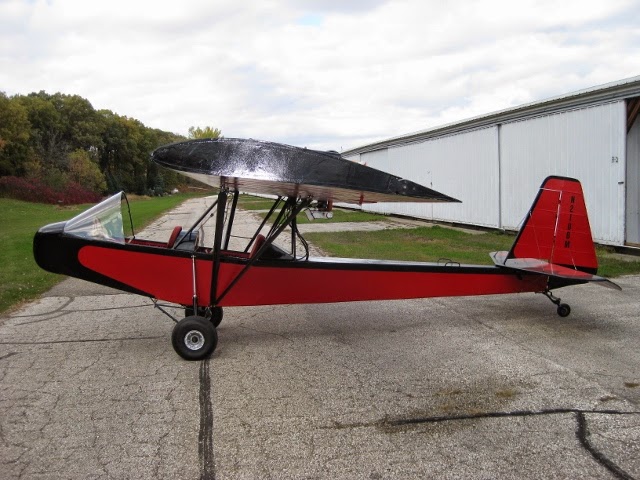
Fast forward 43 years through a lot of different airplanes from J-3 Cubs to jets and here I am, sitting quietly on a grass runway and looking forward over the nose of the Woody's Pusher at the view I want to see when I touch down on the runway. Tom's patient words came back to me. ... Only thing is, there's not much nose to look over since I'm pretty close to hanging 10 on the front end of this thing.


There's nothing to see by looking from right to left, either.


My friend, George, once told me his ambition was to fly an airplane from in front of the engines (plural, as in more than one engine, specifically jet engines, an understandable ambition when a pilot is advancing in the trade). Woody has me flying not only in front of the engine (single, piston-popper) but most everything else as well. 


The real "gotcha" is that most students who are flying tricycle gear airplanes with all those visual cues don't hold a nose-high pitch attitude high enough; my situation is somewhat reversed: I wasn't holding a nose-almost-level pitch attitude almost-level enough, resulting in first contact of the runway by the tailwheel. I've improved my technique quite a bit over the months and improved my chances for landing at least three-point by installing larger tires. Today, thankfully, my landings are again acceptable more often than not and I might be able to keep doing the aviating thing without having to stop to fix a broken tailwheel.


Old dogs can learn new tricks. (Keeps life interesting - and fun). Nowadays, having etched the pitch attitude for landing in my psyche, I just fly Woody to the runway to a half (maybe 3/8) of an inch, allowing the grass to gently brush against and spin up the tires, and just let it drop in from there.


Wednesday, May 28, 2014

In theory ...

... it shouldn't make any difference whether the mass up front is made mostly of metal or flesh and bone (Alex)  as long as the airplane is within weight and CG  limits. However, and for whatever reason, I get the feeling Woody doesn't like crosswinds. 

True, there is a lot of sail area with the high fuel tank and also true, there is a decided difference when the thrust line is way up high instead of along the localizer and glideslope of the fuselage, all of which contribute their bit to the generally squirrelly crosswind characteristics during takeoff and landing. A third factor (and probably the most prominent one) is that I sit in front of the mains so I feel the swings and sways a lot more. I sat in front of the mains in the jet, but it was a tricycle gear airplane. A more appropriate comparison would be an airplane with a tailwheel, like a B-17 or a C-46/47. 

Swings and sways aside, I was having trouble achieving liftoff at what I thought should be a reasonable airspeed so I decided to increase the main tire size from 6.00x6 to 8.50x6 in order to get a little more three-point angle of attack. 

The new tires are great and jacking the mains up 2-1/2 inches helps a lot with the three-point AOA ... that's the good news. So far, there's no bad news to go with it. The airplane has to fly off three-point, or nearly three-point - there's no such thing as a "rotation". If you try, you'll drag the tailwheel and increase the takeoff roll. (I remember an after-action story from the memory bank about this.) Landings are the same; every landing has to be nearly a wheel landing or the tailwheel makes first contact. 

The new tires lowered liftoff and touchdown speed by almost 8 mph. That's a lot but still not near where I'd like them to be. I could try vortex generators along the leading edge but a given airfoil can only do so much and I believe I've done all I can short of a major tweak to the angle of incidence of the wing - maybe I could hand crank an adjustable wing angle of incidence a la F-8 Crusader. 

Slats, flaps, hook and an adjustable wing AOI ... THAT would get some attention at $100 hamburger events. Wes, if you're up there reading along, I'd sure like to have you back with us so you could chime in on this.

John drove with a trailer full of goodies to Woodruff SC this month for a few days of model airplane flying - I happened to be not far away and would have met him there for breakfast on my way back home, but I decided to get a very early start and I know how John feels about being rousted out of the sack. That event is held at Triple Tree, a private airport that belongs to a fellow named Pat Hartness. The runway is like a pool table and landscaping more like a very nice golf course, albeit one with a restored WWII control tower and a private collection of beautiful vintage airplanes.


Pat holds a full-scale fly in every September, which I would very much like to attend with the CallAir this year if it's ready.

While the CallAir is under the knife, I'm having a ball with Woody and he's becoming pretty well known around the local fly-in circuit.


Fly safe ... 

Friday, May 02, 2014

May, 2014, Seven Months into the Callair

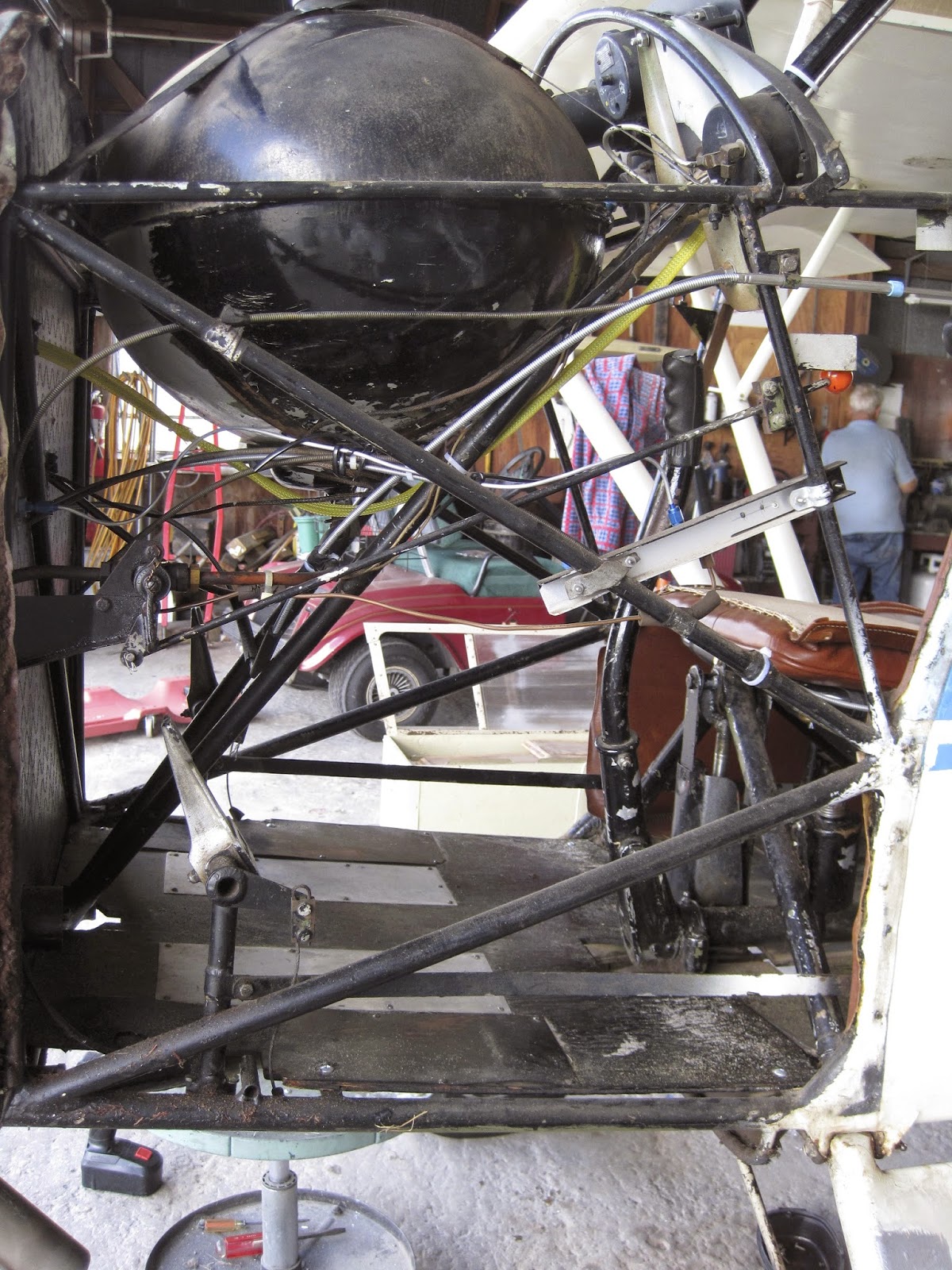
The thing about restoring an airplane is that unless you have an idea of what the process entails, you're likely to think somewhere along the way that it sure looks like an awful mess. Something like watching someone else get a haircut. Have you ever wondered why the barber never has your chair facing the mirror? That's why.

Lots of pictures ... first, a starting weight, then many, many shots of how things went together before ...

How does it go? The head bone connected to the neck bone ... 
etc ...

etc ...

etc ...

By the time an airplane has reached its 62nd birthday it's likely to have picked up a few warts, bruises, and patches.

Peeling back the layers ...

one layer at a time ...

... and the neck bone connected to the shoulder bone ...

Some builder techniques provoke certain questions, usually beginning with "why...?"

The old braking system was right out of Rube Goldberg (or Massey Ferguson) ...

a major goal is FAA approval of a modern brake system that will have continued support.

To be sure, there are repairs and updates required throughout.

I tried to preserve the dirt dauber nest over the tachometer for posterity but it turned to sand in my hands. No telling how old that was ...

Dem bones, dem bones, dem dry bones ...

Even the most seemingly useless pictures can come in handy later when you're trying to figure out where and how and sometimes why things were done the way they were.

...
Then a few parts are readied for re-cover and ...
 
color charts are consulted ...
To take us back to Afton WY in 1952, when it all began.


Wednesday, April 16, 2014

Serendipity

ser-en-dip-i-ty [ser-uhn-dip-i-tee]
noun
1.   an aptitude for making desirable discoveries by accident.
2.   good fortune; luck.

Funny, the more I work at something, the luckier I seem to get. On rainy days there's nothing more handy than the internet for finding out stuff, and so it came to pass that I recalled a conversation last year with an interesting fellow who held a key to the history of my Callair S-1A. He gave me two names; a long year later I decided to look them up.

The first man I spoke to was a gentleman, it turns out, who I spoke with last year in my initial rush to find out more about the airplane. Herb Andersen moved to Afton WY in the 1950s to work for the CallAir Aircraft Company. He was the first to tell me that the Calls never built an S-1A entirely from scratch - the two airplanes were built up from Interstate Cadet parts and somehow one was badged as a CallAir. In my digging, I found a couple of S-1 airplanes called "CallAir" that are no longer on the FAA registry with serial numbers that were in the Interstate range of numbers, but mine was quite different ... it was a CallAir number, one of two aircraft built with that unique feature. I'll give my theory about that later, in another post.

Herb went on to a distinguished career with Mooney, Aero Commander and Piper before meeting with the legendary Curtis Pitts about the idea of moving the manufacturing of the Pitts Special aerobatic airplane to Afton. The result was Pitts' moving his company to Wyoming, joined later by Frank Christensen and the development of the Christen Eagle aerobatic airplane and the Aviat Husky utility aircraft. The robust aircraft manufacturing business in Afton today proceeds directly through these men to Reuel, Barlow and Spencer Call and the CallAir Aircraft Company. In 2010, Herb was awarded the Curtis Pitts Memorial Trophy for Innovative Aerobatic Design, preceded by his induction into the Wyoming Aviation Hall of Fame in 2003.

My next stroke of exceptional luck was to meet by telephone Major General Boyd Eddins, USAF Retired, shown here with his Brigadier stars. In 1952, General Eddins was a teenaged college kid, working in the CallAir Aircraft factory for 60 cents an hour and actually took a hand as my airplane was built. Mr Reuel Call offered to sell it to him for $2,800, more than 60 cents an hour could afford and a sum that would derail the young man's plans for a university degree and a career in the Air Force. 

General Eddins eventually served in a number of public positions, including the Wyoming legislature, before his retirement and, today, enjoys flying his RANS S-6 in the beautiful Star Valley that cradles Afton.

My dilemma with the restoration of this airplane hasn't been so much the nuts and bolts of the operation - Malcolm is in charge and doing a beautiful job of that. The tough part was finding the original paint scheme and colors. Nobody seemed to remember other than a black and white photo of Serial Number 1001 and the nugget that Barlow Call, owner of 1001, liked red and white airplanes. But what about Serial Number 1002, Mr. Reuel Call's airplane? The answer came as a complete surprise: General Eddins so loved that airplane that he kept a color photograph of it sitting in the final assembly building, framed in his home:
It is yellow with a blue accent, edged in white; Reuel Call's favorite airplane colors.

So now we know. Everyone with even a passing interest in the restoration of this airplane has a new spark of excitement. The paint order will go out next month and with Malcolm proceeding apace with covering, there is a glimmer of light at the end of the tunnel.